
Building a Panel Procurement Plan Around Mill Lead Times
Two published windows set the rhythm of a panel order: 2 to 10 weeks after confirmation and deposit on structural three-layer plywood, and 15 to 25 days on standard formwork beams against 20 to 30 days for customised ones. Those four numbers decide the date the purchase order has to be written. Every figure below is quoted from pages published by Dongstar Group.

Key takeaways
- Structural three-layer plywood is published at 2–10 weeks after order confirmation and deposit, with one 20-ft container or the equivalent as the usual minimum.
- Timber formwork beams run 15–25 days standard and 20–30 days customised, with OEM or ODM work available.
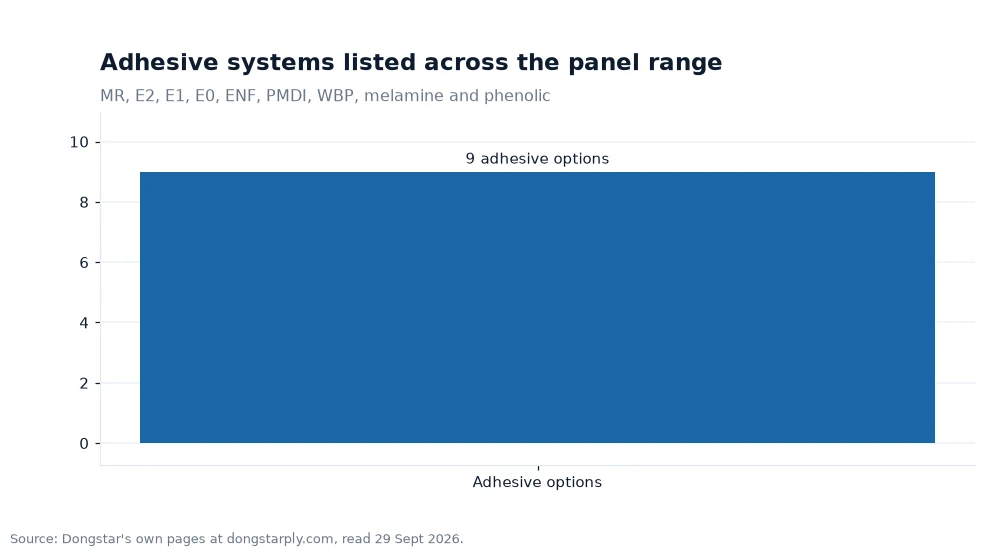
- Nine adhesive options are listed across the strand board and chipboard pages, and the choice sits in the production schedule rather than beside it.
- FOB, CIF and DDP terms are all offered, and each one changes who books freight and when the clock starts.
Two published lead-time windows and what they cover
The three-layer plywood page states a lead time of two to ten weeks from order confirmation plus deposit, with scheduled shipments available as standard on long-term contracts. On the formwork beam line the published figures are fifteen to twenty-five days for a standard order, and twenty to thirty days once the specification is customised. Read together, they describe two different kinds of production: one scheduled in weeks for pressed panel runs, one measured in days for a repeat-manufactured section.
A plan built on the short end of either window is a plan that assumes nothing goes wrong. Both windows describe work scheduled at the group's plant in Linyi city, so the calendar follows production capacity rather than stock on hand. The useful way to use the figures is to take the long end as the working date and treat the short end as an upside. Buyers who forecast on the downside protect their site programme; buyers who forecast on the upside spend the difference explaining a delay.
The minimum order is the other half of the plan
Order size and lead time are decided together. For wholesale and bulk orders the usual minimum on structural three-layer plywood is one 20-ft container or the equivalent volume, and larger projects are described as negotiable. Below that line the conversation moves to samples and trial orders rather than production slots.
That matters for planning because a container is a fixed unit of freight, not a fixed unit of board. One 20-ft container of 1220 × 2440 mm sheets at 2.98 m² each is a different number of square metres from a container of 1250 × 2500 mm sheets at 3.125 m² (example arithmetic), while the freight line on the invoice stays the same. The mix of formats inside the container therefore decides the landed cost per square metre, long before any price negotiation starts.
Adhesives sit in the schedule, not beside it
The strand board and chipboard pages list nine adhesive systems between them: MR and the E2, E1 — E0 emission classes, plus ENF, PMDI, WBP, melamine and phenolic. The as standard lists are published as options rather than as a single standard offer, and the description attached to each one explains what it is for, from indoor economy to moisture resistance and low formaldehyde release.
An adhesive change is not a clerical detail on a production line. Different resin systems run at different press conditions, and switching from one to another can mean a separate run rather than a longer one. A procurement plan that fixes the adhesive on the first email avoids a re-quote later, and a plan that leaves it open keeps the schedule flexible at the cost of a moving specification.
Incoterms decide when the clock starts
FOB, CIF and DDP are all available on the structural plywood range, and packing is described as palletised and wrapped, trucked into containers at port, with either the supplier booking freight or the buyer's forwarder being accepted. The three terms move responsibility for the sea leg, the insurance and the final delivery in different directions.
The planning consequence is who owns the risk window after the mill finishes. Under FOB the buyer's timeline starts at the port; under CIF the supplier arranges carriage and the buyer owns it from the destination port; under DDP the supplier carries the shipment to the delivery address. Two identical production lead times can therefore produce two very different arrival dates.
What to fix in the purchase order
Six fields carry most of the schedule risk: sheet format, thickness and tolerance, face and core, adhesive, certificate set, and packing. The three-layer page adds FSC, CE and E0 or E1 formaldehyde certificates as available on request, and the beam page lists third-party inspection reports. Each of those, if requested late, can add a step that was not in the original window.
Write the shipment window in the same section as the specification. A purchase order that names a 1220 × 2440 mm sheet, an 18 mm thickness with a ±0.5 mm tolerance, a WBP melamine glue line and a palletised pack gives the mill one configuration to schedule. A purchase order with three of those fields open gives it a question to answer first. A Plywood Supplier who states a minimum, a production window and a packing route in the first reply has answered the schedule question before it is asked.
| Stage | Published figure | How to plan around it |
|---|---|---|
| Structural three-layer plywood | 2–10 weeks after confirmation and deposit | Book the long end, treat the short end as upside |
| Timber formwork beams | 15–25 days standard, 20–30 days customised | Add the customisation step before the run |
| Minimum order | One 20-ft container or the equivalent | Size the first order to fill the container |
| Trade terms | FOB, CIF, DDP | Pick the term that matches who moves the cargo |
Worked example: sizing an order to one container
Suppose a project needs 3,000 m² of panel. In the 1220 × 2440 mm format, at 1.22 m × 2.44 m = 2.98 m² per sheet, that is 3,000 ÷ 2.98 = 1,006.7, so the order needs 1,007 sheets (example arithmetic). In the 1250 × 2500 mm format, at 1.25 m × 2.5 m = 3.125 m², it is 3,000 ÷ 3.125 = 960 sheets exactly (example).
The second format needs 47 fewer panels for the same area, but it also needs a cut list that can live with 2500 mm lengths. Then add the calendar: if the deposit clears on 1 March and the mill runs the long end of the published window, ten weeks puts the shipment at about 10 May, and the site programme should be built backwards from that date rather than forwards from the enquiry (example dates).
Frequently asked questions
Why does a one-container minimum matter if the order is larger?
Because it defines the smallest production opportunity the mill will schedule. A first order below that line is treated as a sample or trial rather than a production slot, which is a different process with a different cost structure and a different calendar.
Can a customised order be run in the standard lead time?
The two windows are published separately: 15 to 25 days for standard formwork beams against 20 to 30 days for customised ones. A customised specification needs its own tooling and paperwork steps, so it is planned as a different job rather than a faster version of the standard one.
Which certificates arrive with a structural order?
The three-layer plywood page lists FSC, CE and E0 or E1 formaldehyde certificates as available on request, and the formwork beam page names third-party inspection reports. Ask for the ones your market needs and treat the rest as optional.
Turning the figures into a schedule
Buyers who want the production windows in their original wording can read the structural three-layer plywood page and then compare the day-based windows on the timber beam specifications. Put both beside your own shipping calendar before the first order, not after it.
Lead times, minimum order quantities, trade terms and packing notes given here appear on the maker's own website, as read on 29 September 2026, and used throughout these notes[1].